
Why your strategy tester fills are fantasy
The strategy tester has to guess what happened inside each candle, and its guesses lean optimistic. Those guesses can be the entire difference between a winning and losing system.
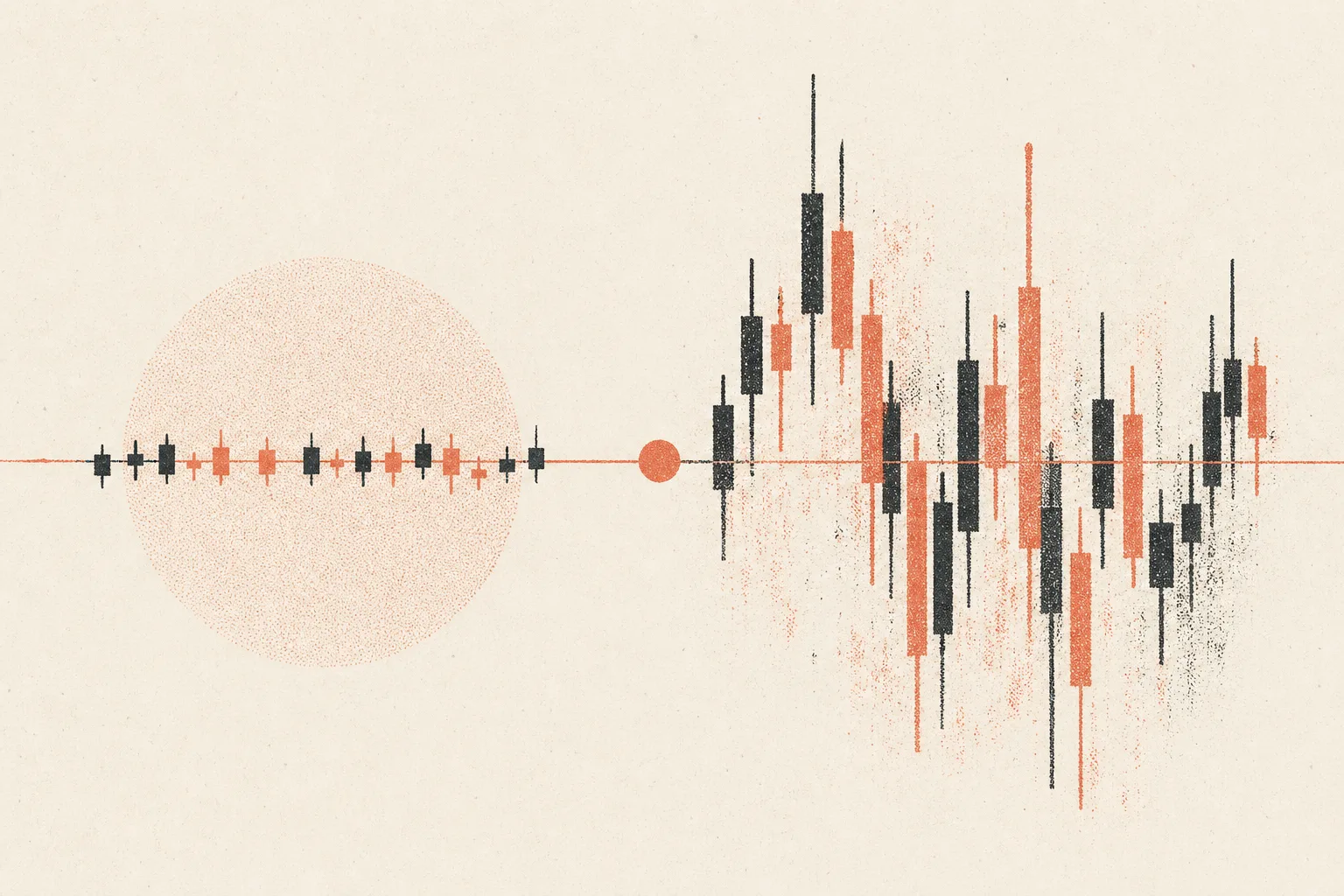
A backtest reports a fill price as if it’s a fact. You entered here, you exited there, the profit was exactly this. It’s presented with the confidence of a bank statement. But a good chunk of those fills never happened, and couldn’t have, because the tester was guessing about events it had no way to see.
Once you understand what it’s guessing, a lot of suspiciously good backtests start to make sense, and not in a flattering way.
The tester only sees four prices per candle
This is the root of it. On historical data, a strategy tester usually knows four numbers for each candle: the open, the high, the low, and the close. It does not know the order those happened in. Inside that candle price might have wiggled up first then down, or down first then up, or zigzagged a dozen times. The tester has no record of the path. It only has the four corners.
So when your stop and your target both sit inside a single candle’s range, the tester has to guess which got hit first. And the assumptions it makes about that guess quietly decide whether a trade is a win or a loss.
The guesses lean kind
Here’s where it gets expensive. Many testers default to optimistic assumptions. If a candle’s range covers both your entry and your target, it may assume you got filled at your ideal price and the target was reached cleanly, when in reality price might have spiked through your stop first and only then run to target. On paper, a win. In life, you were stopped out before the move you got credit for.
Multiply that across hundreds of trades and the gap is enormous. A strategy that looks profitable can be underwater the moment you replace fantasy fills with realistic ones, because the edge was living entirely in the tester’s generosity about what happened inside the candles it couldn’t see.
Slippage and spread aren’t optional
The fills are also clean in a way real life never is. The backtest fills you at the exact price. The real market makes you cross a spread, and in fast conditions, gives you slippage on top. A few ticks per trade sounds trivial. On a strategy that trades often for small edges, a few ticks per trade is frequently the entire edge. A system that’s marginally profitable with perfect fills is reliably a loser once it pays the real cost of getting in and out.
How to keep yourself honest
A few habits help. Trade on the assumption that whenever a stop and target share a candle, the stop got hit first. It’s pessimistic, and that’s the point: you want the unkind version of your results, because the market will give you the unkind version. Build in realistic costs, a spread and some slippage, and watch how the curve changes. A robust strategy survives the haircut. A fragile one evaporates, and you’d much rather find that out in testing than with money on.
The strategy tester isn’t lying to you on purpose. It’s filling in gaps it can’t see, and it fills them in your favour. Treat every reported fill as a best case, assume the market will do the opposite, and the backtests that survive that pessimism are the only ones worth trusting with real money.
The useful version
The Strategy Tester does not know the real path price took inside a historical candle unless you give it lower-timeframe information. It has OHLC and a fill model.
That matters for stops, limits, and any strategy that depends on intrabar order. A candle can show both your target and stop were touched. The tester still has to decide which happened first. If your edge depends on that order, the report is only as good as the model.
What to check
Use the tester report as a question, not a verdict:
- Are entries market, stop, or limit?
- Can target and stop both be touched inside one bar?
- Is bar magnifier or lower-timeframe testing enabled?
- Does live behaviour match the tester’s assumed fill sequence?
If a strategy only works because every ambiguous candle resolves in your favour, it is not a strategy. It is a generous simulator.